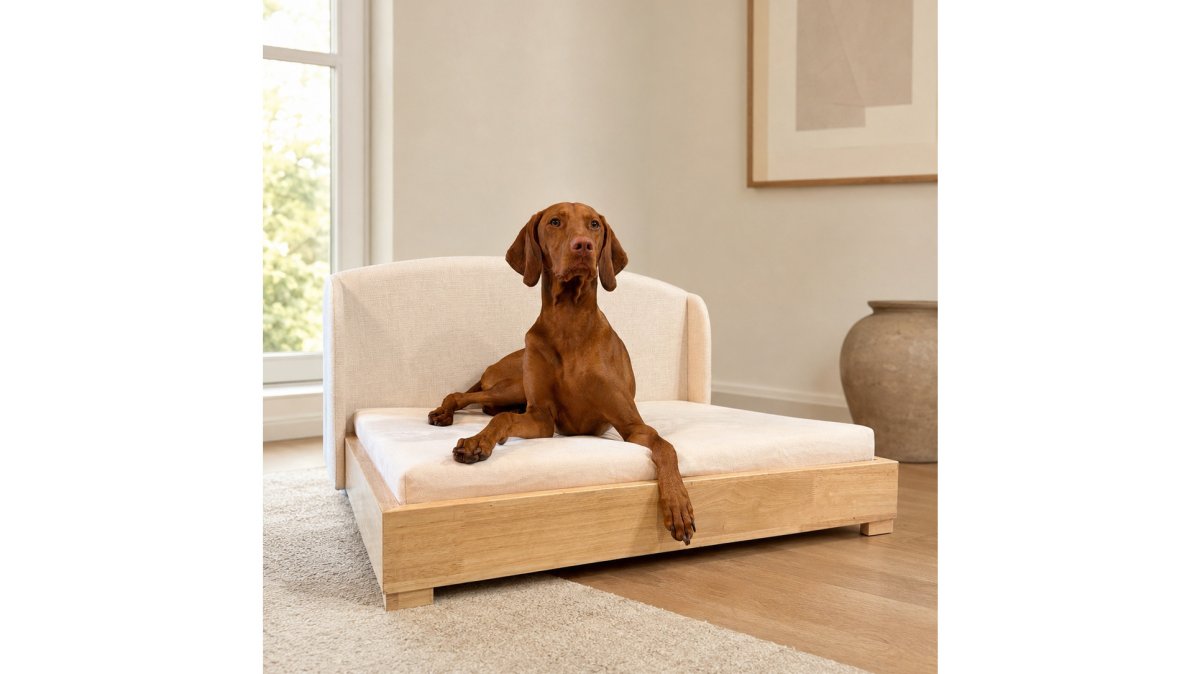
How to Measure Large Dogs for Beds: Size Guide
Table of Contents
- Why Measuring Your Large Dog Matters Before Buying a Bed
- How to Measure a Dog for a Bed: Step-by-Step
- How Much Room Should a Dog Bed Have?
- Using a Dog Bed Size Calculator or Size Chart
- XL Dog Bed Dimensions and Weight Limits
- How to Measure Large Dogs for Beds: 3 Common Mistakes to Avoid
- How to Measure Large Dogs for Beds: The Mafé Haven Fit
- Conclusion: Get the Right Fit the First Time
- Frequently Asked Questions
Last Updated: October 12, 2026
Why Measuring Your Large Dog Matters Before Buying a Bed
A dog bed that's too small forces your dog to curl tight or hang over the edge, landing pressure right on the hips and shoulders.
Most owners buy a bed by eyeballing their dog next to a product photo, which is why so many beds end up in the garage.
This guide from Mafé Pets walks through how to measure large dogs for beds, step by step, the numbers, the size chart logic, and the mistakes that lead to returns.

How to Measure a Dog for a Bed: Step-by-Step
To measure a dog for a bed, capture three numbers: nose to base of tail, body width at the widest point, and the height your dog needs to lie flat. Take all three while your dog is relaxed and lying down.
What you'll need:
- A soft measuring tape
- A helper (for wiggly dogs)
- A notebook or phone to record numbers
- A few treats
Measure Nose to Base of Tail
Start at the tip of the nose. Run the tape along the spine to the base of the tail, not the tip. This is your dog's body length.
Do not measure the tail. A tail adds length that doesn't need bed space. For a large dog, this number usually lands between 30 and 40 inches.
Measure While Your Dog Is Lying Down
This is the measurement most guides skip, and it matters most: a standing dog is shorter than a sprawled one.
Wait until your dog settles into their natural sleeping position. Then measure from the front of the nose to the base of the tail again. Lying-down length often runs 2 to 4 inches longer than standing length.
Measure Width at the Widest Point
Width is the number people forget. Measure across the widest part of the body, usually the shoulders or ribcage.
A dog that sleeps on its side needs a bed as wide as its body plus room to stretch. A dog that curls can use a rounder, tighter bed.
How Much Room Should a Dog Bed Have?
A dog bed should give your dog 8 to 12 inches of extra length beyond their body measurement, so they can stretch out, shift position, and sprawl without hanging off the edge.
Here's a simple rule: measure your dog lying down, then add the buffer.
- Curler: add 8 inches of length
- Side sleeper: add 10 inches of length
- Sprawler: add 12 inches or more
- Senior dog: add extra width for stiff joints
That buffer is not wasted space. It's what lets a large dog fully relax instead of bracing to stay on the bed.
Using a Dog Bed Size Calculator or Size Chart
A dog bed size calculator is only as good as the numbers you feed it. The bigger problem: most charts sort by weight, while fit is decided by length and usable sleeping surface.
Most size charts sort beds into four bands. Use this one as a starting point, then check actual bed dimensions.
| Size | Body Length (nose to tail base) | Typical Weight | Best For |
|---|---|---|---|
| Medium | 20-25 in | 25-40 lb | Corgis, small spaniels |
| Large | 26-32 in | 40-60 lb | Labs, boxers |
| XL | 33-40 in | 60-90 lb | Goldens, German shepherds |
| XXL | 40+ in | 90+ lb | Great Danes, mastiffs |
Weight matters as much as length: a heavy dog needs a thicker, denser base so it doesn't bottom out.
How to Read a Size Chart Without Getting Burned
Charts disagree, and that's normal, a bed labeled XL by one maker can match another's XXL. Three checks close the gap:
- Find the sleeping surface number, not the outer size. If the listing only gives outer dimensions, treat the bed as smaller than advertised.
- Compare your lying-down length to the surface length, not the frame length. Your dog needs the surface to exceed their body length by the buffer you chose above.
- Check the weight rating separately. Length fit and weight support are two different specs. A bed can be long enough and still flatten under a heavy dog.
Between-Size Decisions: When to Size Up
You'll often land between two bands. Use this rule instead of guessing:
- Size up if your dog sprawls, sleeps on their side, or has joint discomfort. A side sleeper's body is widest at the shoulders and hips, and those points need flat surface, not a bolster.
- Size up if your dog is still growing. Young large breeds can add height and length for 12 to 18 months. A bed that fits at eight months may be tight at eighteen.
- Stay at the smaller band only if your dog curls tightly and the surface still clears their body length plus 8 inches.
- Never size up past your room's footprint without measuring the floor space first. An oversized bed that blocks a doorway gets returned.
Bed Shape Changes Usable Surface
Two beds with the same outer dimensions can offer very different sleeping area:
The Haven | Solid Hardwood Orthopedic Dog Bed →
- Rectangular with low sides: the most usable surface per inch of footprint. Best for sprawlers and side sleepers.
- Rectangular with high bolsters: the bolsters eat 4 to 8 inches on each long side. Measure the flat interior, not the rim.
- Round or oval: good for curlers, but the corners of a rectangle are wasted on a round bed. A round bed needs a larger diameter to match the usable area of a rectangle.
- Nest or cuddle style: the raised rim supports the head and neck, but a large dog who stretches out will hang over the edge.
XL Dog Bed Dimensions and Weight Limits
XL dog bed dimensions typically start around 40 by 30 inches and go up. But outside size and usable sleeping surface are two different numbers, and for a large or heavy dog that gap decides whether the bed works.
A bed with thick bolsters can measure 45 inches wide while the flat sleeping area is only 32 inches. When you compare beds, look for the sleeping surface, not the outer frame, that's the number that decides whether your dog fits.
How to Verify the Real Sleeping Surface
Confirm the usable surface three ways, in order of reliability:
- Read the spec sheet for an interior measurement. Listings that give only outer dimensions are hiding the number you need.
- Subtract the bolster depth. If the bed lists a 45-inch outer width and 6-inch bolsters on each side, the flat interior is roughly 33 inches. Do the same for length.
- Measure the bed in person if you can. Lay a tape across the flat area between the bolsters, not across the rim.
A quick sanity check: your dog's lying-down length plus your buffer should be less than or equal to the interior length. If it isn't, the bed is too small no matter what size label it carries.
Mattress Thickness and Support for Heavier Dogs
Length and width fit are only half the equation. A heavy dog also needs a mattress that won't bottom out. Two specs matter:
- Thickness: a 2-inch pad compresses to almost nothing under a 90-pound dog. Look for 3 to 4 inches of foam or more for large and giant breeds.
- Foam density and type: high-density memory foam or a dense support core holds up better than soft shredded fill, which packs down over time. A bed rated for 50 pounds will flatten under a 70-pound dog within months.
Match the bed's weight rating to your dog's current weight, plus room to grow. If your dog is between ratings, choose the higher one, sizing up on support costs far less than replacing a collapsed bed.
Weight Capacity: What the Rating Actually Means
A weight rating is the load the bed supports without permanent compression. It's not a hard limit, but exceeding it shortens the bed's life and reduces support, for a senior large dog, that shows up as stiffness getting up in the morning.
How to Measure Large Dogs for Beds: 3 Common Mistakes to Avoid
The three mistakes that ruin most bed purchases: measuring a standing dog, skipping width, and ignoring how your dog sleeps.
- Measuring while standing. A standing dog is shorter than a sprawled one. You'll buy a bed that's too short.
- Forgetting width. Length gets all the attention. Width decides whether a side sleeper fits.
- Ignoring sleep style. A curler and a sprawler of the same length need very different beds.
One more trap: measuring once and never again. Young large breeds keep growing, so a bed that fits at eight months may be tight at eighteen. Re-measure every few months until growth levels out.
How to Measure Large Dogs for Beds: The Mafé Haven Fit
At Mafé Pets, we built the Haven around the measurement method in this guide.
That surface sits on a solid North American hardwood frame, cut and joined by hand.
The Haven also solves the cleaning problem that ruins most beds.
If your dog is over 55 pounds, measure carefully and check the sleeping surface against your numbers. The Haven suits dogs up to 55 pounds.
Conclusion: Get the Right Fit the First Time
Getting the measurement right takes five minutes and saves a return, a refund, and a restless dog.
At Mafé Pets, we make that last step easy. The Haven pairs a 35 by 26 inch orthopedic sleeping surface with solid hardwood construction, a sealed waterproof liner, and a machine-washable cover. It's guaranteed for ten years.
Shop the Haven and give your large dog a bed that actually fits.
Frequently Asked Questions
How large should a dog bed be for a large dog?
A large dog bed should be at least as long as your dog from nose to base of tail, plus extra room for stretching. Add 8 to 10 inches to the body length and 4 to 6 inches to the width. For dogs that sprawl, add 10 to 12 inches. The bed must also support your dog's weight; for example, the Mafé Haven supports dogs up to 55 lb and offers a 35″ × 26″ sleeping surface.
How do you measure a dog for a bed if they won't stay still?
Measure your dog while they are asleep or relaxed. Place a soft tape measure or a piece of string from the tip of the nose to the base of the tail, then measure the string. For width, measure across the widest part of the body, usually the shoulders or hips. If your dog moves, take multiple measurements and use the largest. Alternatively, measure their favorite sleeping spot and add a few inches.
What are the typical XL dog bed dimensions?
XL dog beds generally range from 40 to 50 inches in length and 30 to 40 inches in width. For example, a bed for a large breed like a Labrador might be 44″ × 32″. Always check the specific product's dimensions and weight limit. The Mafé Haven, for instance, has a 35″ × 26″ sleeping surface and is designed for dogs up to 55 lb.
How much extra room should a large dog bed have?
Add 8 to 10 inches to your dog's body length and 4 to 6 inches to their width. This allows them to stretch out and change positions. If your dog sleeps sprawled, add 10 to 12 inches to the length. For dogs that curl up, you can add slightly less, but never less than 6 inches total. The goal is a bed that feels secure but not cramped.

