Why Cheap Dog Beds Are Waste: The Real Cost
Table of Contents
- The Hidden Math of Cheap Dog Beds
- Signs of a Low-Quality Dog Bed You Shouldn't Ignore
- Orthopedic Memory Foam Dog Bed Benefits for Joint Support
- Durable Dog Beds for Chewers: What Actually Holds Up
- The Environmental Cost: Landfill Waste and Non-Biodegradable Foam
- Repair, Repurpose, and Dispose: What to Do With Old Beds
- Cost-Per-Use: Why a $360 Bed Can Beat a $60 Bed
- Frequently Asked Questions
Last Updated: September 12, 2026
The Hidden Math of Cheap Dog Beds
The average dog bed gets replaced every six to twelve months, and that replacement cycle is where the real money disappears. Cheap dog beds are waste not because they cost less up front, but because they fail fast, shed foam, and end up in a landfill while you shop for another one. At Mafé Pets, we build furniture-grade beds from solid North American hardwood and orthopedic memory foam. This guide breaks down the true cost of disposable pet products, from filling settlement to landfill waste, and shows why a well-built bed often costs less per year of use than a bargain bin replacement.


Most shoppers compare sticker prices. A $60 bed looks like a bargain next to a $360 frame-and-mattress piece. That comparison ignores how many $60 beds you'll buy in the same window. The EPA's guidance on reducing household waste makes the point plainly: products designed for short lifespans generate the bulk of municipal solid waste, and pet accessories are no exception.
Here's the number that matters most: cost-per-use, not cost-per-purchase.
Signs of a Low-Quality Dog Bed You Shouldn't Ignore
A low-quality dog bed shows its weaknesses within weeks: the filling settles into lumps, seams pull apart, and the cover pills or tears at the zipper. Watch for these red flags before you buy:
- Filling settlement within the first month, leaving a thin, flat pad where your dog actually lies
- Synthetic fibers that pill, snag, and trap odor even after washing
- Thin, non-removable covers that can't be machine washed without warping
- Stapled or glued frames instead of real joinery
- No warranty or a warranty that excludes the most common failures
Filling Settlement and Structural Collapse
Filling settlement is the slow collapse of a bed's core under your dog's body weight. Low-density foam and shredded fill compress permanently, so the bed loses loft and support long before the fabric wears out. Structural collapse follows: the bed sags in the middle, the bolster flattens, and your dog starts avoiding it altogether.
The fix is material density. High-density foam and orthopedic memory foam resist compression and recover their shape. Cheap beds use the lightest foam that passes a visual check, which is why they flatten so quickly.
Synthetic Fabrics and Chemical Off-Gassing
Synthetic fabrics and chemical off-gassing show up in the same cheap bed. Petroleum-based foam and low-grade synthetic covers can release volatile organic compounds, the source of that sharp "new bed" smell. That odor fades, but the material breakdown doesn't. Synthetic fibers also shed microplastics with every wash, adding to the environmental footprint of a product you'll replace within the year.
Orthopedic Memory Foam Dog Bed Benefits for Joint Support
Orthopedic memory foam dog bed benefits come down to pressure distribution: the foam conforms to your dog's body, spreads weight evenly, and reduces the concentrated pressure that aggravates hips and joints. For aging dogs, that shows up in how easily they rise after a nap; for younger dogs, it's preventive support that protects joint health over a lifetime.
The cost of getting it wrong shows up at the vet, not at the pet store.
What a Flat Bed Actually Does to a Dog's Body
When a cheap bed settles into a thin, compressed pad, your dog is effectively lying on the floor with a fabric cover over it. Body weight concentrates on the elbows, hips, and hocks, the bony prominences with the least soft tissue to cushion them. Over months, that repeated pressure produces the pattern most veterinary practitioners describe in aging dogs: stiffness on rising, reluctance to lie down, shifting weight forward onto the front legs, and a slow loss of willingness to climb stairs or jump into the car.
It becomes a bedding problem because the dog cannot tell you the bed is the cause. Owners typically notice the mobility change first and assume it is age. By the time the dog is diagnosed with osteoarthritis or a soft-tissue injury from chronic compensation, the cheap bed has already been replaced two or three times, and the joint damage is not reversible.
The Veterinary Cost Nobody Puts in the Comparison
This is the part of the cost-per-use math that cheap-bed marketing depends on you ignoring. A single veterinary visit for a lameness workup, exam, radiographs, and anti-inflammatory medication, routinely runs into the hundreds of dollars. If the dog is referred to an orthopedic specialist, imaging and a treatment plan can run into the thousands. Physical rehabilitation, joint supplements, and prescription diets for osteoarthritis are ongoing monthly costs, not one-time ones.
A common pattern in multi-dog households is that the dog with the cheapest bed ends up on the most expensive long-term care. Support is a load-bearing variable in joint health, and a bed that stops supporting after six months stops protecting after six months.
What "Support" Actually Means in Foam Terms
Support is not softness. A bed can feel plush and still provide almost no support, which is exactly what low-density foam does, it compresses to the floor under load and never recovers its loft. What you want is a foam that holds its shape under a dog's body weight and returns to it when the dog gets up.
That is the practical difference between a low-density fill and a true orthopedic memory foam mattress. The memory foam conforms to the body, distributes load across a wider surface area, and reduces the peak pressure at the elbows and hips. The AAHA's resources on senior dog care note that joint comfort and mobility are central to quality of life in older dogs, which makes bedding a health decision, not just a comfort one.
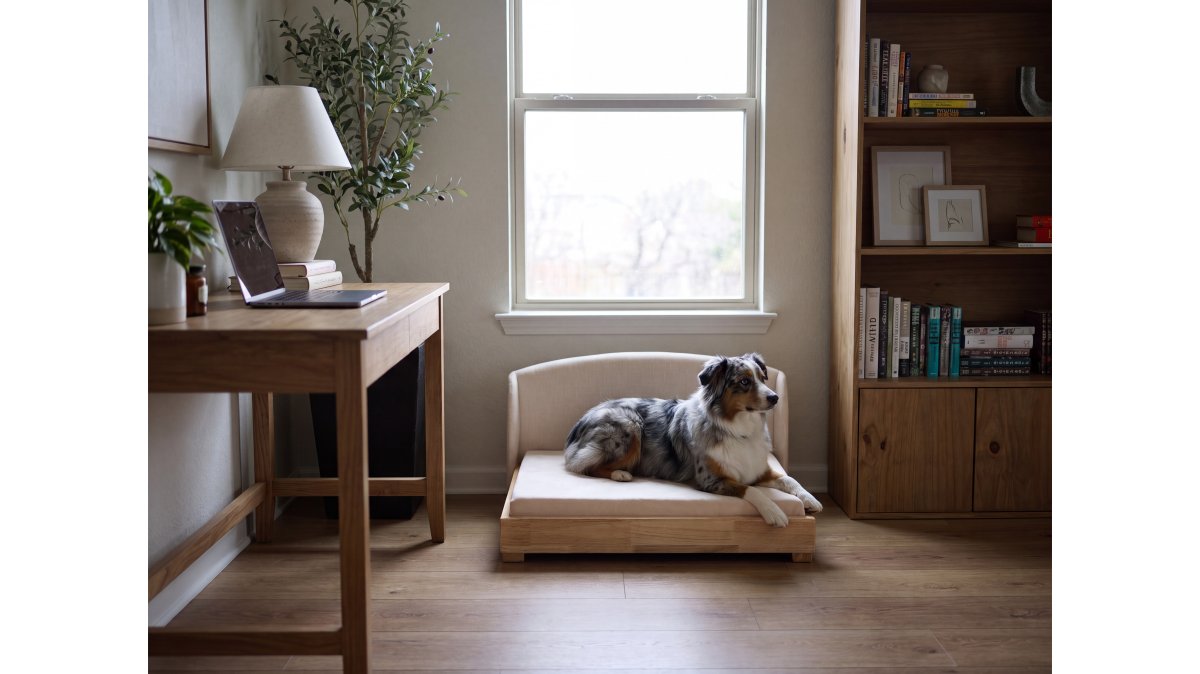
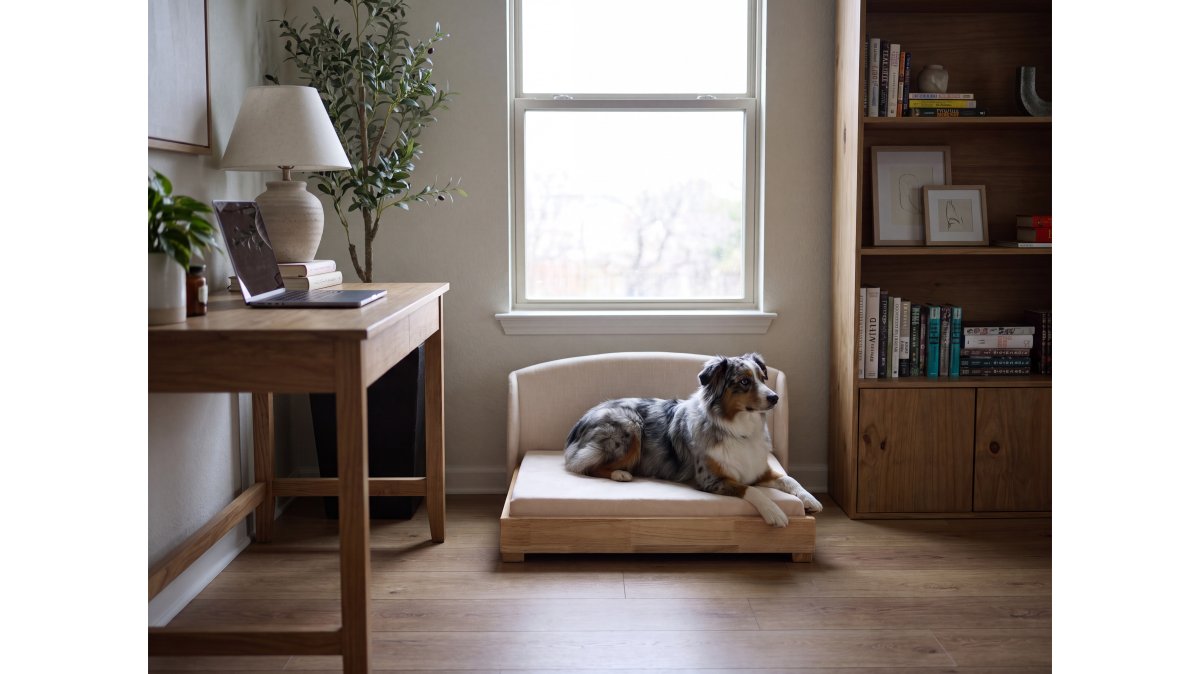
Our Haven bed pairs an orthopedic memory foam mattress with a waterproof liner and a machine-washable cover, so the foam core stays protected from accidents and spills. That liner is the difference between a mattress that lasts and one that degrades from the inside, and a mattress that still supports your dog in year eight has already paid for itself in avoided mobility problems.
Durable Dog Beds for Chewers: What Actually Holds Up
Durable dog beds for chewers are built around structure, not padding. A determined chewer will destroy a soft, unstructured bed in days. What survives is a solid frame, real joinery, and covers that resist pulling and tearing at the seams:
- Solid hardwood frames with joinery, not particleboard or stapled corners
- Reinforced seams and heavy-duty zippers on removable covers
- Dense foam cores that don't shred into small, swallowable pieces
- Waterproof liners that keep the mattress intact even after accidents
The Environmental Cost: Landfill Waste and Non-Biodegradable Foam
Landfill waste is the endgame for every disposable bed. Petroleum-based foam is non-biodegradable, so a discarded bed sits in a landfill for generations, breaking into smaller fragments rather than decomposing. Multiply that by the replacement cycle, and a single dog can account for a stack of discarded beds over its lifetime.
The material science underneath is where cheap beds separate from durable ones.
Why Cheap Foam Is a Different Waste Category
Not all polyurethane foam is the same. The foam in a bargain bed is typically low-density, the manufacturer uses the least material that still passes a visual inspection and holds a shape on the shelf. Two consequences matter for waste:
- It fails faster. Less material means less resistance to compression, so the foam flattens, crumbles, and sheds. A bed that fails in six months generates roughly twenty times the waste of a bed that lasts ten years, per year of use.
- It sheds as it fails. Cheap foam does not stay inside the cover. It breaks down into crumbs and dust that migrate through seams, into the cover, and into your home. That material ends up in the trash in pieces, not as one recyclable unit, which makes it effectively unrecoverable.
A high-density foam core, by contrast, holds its structure. When the bed finally reaches end of life, it does so as one intact mattress that can be recovered, re-covered, or repurposed, not as a trail of foam crumbs spread across a decade of vacuum bags.
The Off-Gassing Problem Nobody Quantifies
Petroleum-based foam and low-grade synthetic covers can release volatile organic compounds, the source of that sharp "new bed" smell. In a cheap bed, that smell is not cosmetic. It signals that the foam was manufactured with a higher proportion of low-cost blowing agents and residual chemicals that continue to migrate out over time.
Off-gassing and structural failure are the same failure mode seen from two angles. The chemistry that makes foam cheap to produce is also the chemistry that makes it break down faster. A bed that smells strongly for a week is a bed whose foam is already losing its integrity.
The Compounding Footprint of the Replacement Cycle
The environmental footprint compounds with each cheap purchase. Every replacement bed represents a new round of raw material extraction, manufacturing, shipping, and eventual disposal. A bed that lasts years keeps one frame and one mattress out of the waste stream. A bed that lasts months feeds a steady cycle of manufacturing, shipping, and disposal, and the shipping footprint alone, repeated every six to twelve months, dwarfs the one-time cost of moving a single durable bed.
Waste reduction starts with product lifespan, and lifespan is a design decision made long before you bring the bed home. The EPA's guidance on reducing household waste makes the point plainly: products designed for short lifespans generate the bulk of municipal solid waste, and pet accessories are no exception. The FTC's guidance on environmental marketing claims is worth knowing here too: terms like "recyclable" and "eco-friendly" have specific meanings, so verify what a disposal or recycling program actually accepts before you rely on it.
Repair, Repurpose, and Dispose: What to Do With Old Beds
Repurposing and upcycling extend a bed's useful life before disposal becomes the only option. When a bed reaches the end of its run, you have better choices than the trash bin:
- Repair what's fixable. Replace a worn cover or add a new liner if the frame and foam are still sound.
- Repurpose the materials. Clean foam can become a crate pad or a car seat cushion.
- Donate. Shelter donations are welcome when a bed is clean and structurally intact. Call ahead to confirm what local shelters accept.
- Recycle textiles. Textile recycling programs accept fabric covers in some areas, so check local waste management guidance.
The FTC's guidance on environmental marketing claims is worth knowing here: terms like "recyclable" and "eco-friendly" have specific meanings, so verify what a disposal or recycling program actually accepts before you rely on it.
Cost-Per-Use: Why a $360 Bed Can Beat a $60 Bed
Cost-per-use is the only comparison that matters, and it favors durable construction every time. Divide the purchase price by the number of years the bed stays supportive. A $60 bed replaced twice a year costs $120 annually. A $360 bed that holds up for a decade costs $36 per year, before you factor in the time spent shopping, the waste generated, and the joint support your dog loses in between.
| Factor | Cheap Bed ($60) | The Haven ($360) |
|---|---|---|
| Expected lifespan | 6-12 months | 10+ years |
| Annual cost | $60-$120 | ~$36 |
| Frame | Particleboard, stapled | Solid North American hardwood |
| Mattress | Low-density foam | Orthopedic memory foam |
| Cover | Often non-removable | Machine-washable, waterproof lined |
| Warranty | None or 30 days | 10-year structural |
Quality assurance is what you're really buying: real joinery, a waterproof-lined mattress, and a warranty that backs the structure. The Modern Day Bed at $175 and The Circle at $125 bring the same high-density foam and washable, waterproof-lined construction to smaller footprints and lower price points.
The cheapest bed is rarely the least expensive. Cost-per-use, not sticker price, tells you what you're actually paying for comfort and durability.
Frequently Asked Questions
Are cheap dog beds actually safe for my dog's joints?
Cheap dog beds typically use low-density foam that flattens within months. Once the filling settles, your dog's weight rests on the floor, not on supportive cushioning. This lack of joint support can aggravate existing arthritis and hip issues, especially in aging dogs. A high-density orthopedic memory foam bed, like those with waterproof liners and machine-washable covers, maintains its shape and distributes weight evenly, which helps relieve pressure on joints over years of use.
How often do you have to replace a low-quality dog bed?
Most low-quality beds need replacing every 6 to 12 months. The foam compresses, the cover tears, and washing often accelerates breakdown. Over five years, that's five beds at $60 each, totaling $300 with nothing to show for it. A durable dog bed for chewers with a solid frame and high-density foam can last a decade or more, making the cost-per-use far lower despite a higher upfront price.
What are the environmental impacts of cheap, petroleum-based foam beds?
Cheap beds rely on petroleum-based foam and synthetic fibers that are non-biodegradable. When they wear out, they go straight to landfill waste, where they can take centuries to break down. The replacement cycle multiplies the problem: buying a new bed every year means five times the waste over five years. Choosing a repairable, long-lasting bed reduces your environmental footprint and supports a more circular approach to pet products.
What makes a dog bed furniture-grade compared to mass-produced versions?
Furniture-grade dog beds use solid North American hardwood frames with real joinery, not particleboard or staples. The mattress is high-density orthopedic memory foam with a waterproof liner, and the cover is machine-washable. Mass-produced beds cut corners with synthetic filling, glued frames, and thin fabrics that fail within a year. A furniture-grade bed like The Haven is built to be repaired and refinished, backed by a ten-year structural warranty, and designed to complement your home rather than clutter it.
The real challenge isn't finding a cheaper bed. It's breaking the replacement cycle that keeps sending flattened foam to the landfill and your dog back to the floor. Mafé Pets builds furniture-grade beds to end that cycle: solid North American hardwood frames, orthopedic memory foam mattresses, waterproof liners, and machine-washable covers, all backed by a ten-year structural warranty. Shop the Haven and give your dog support that outlasts the bargain bin.