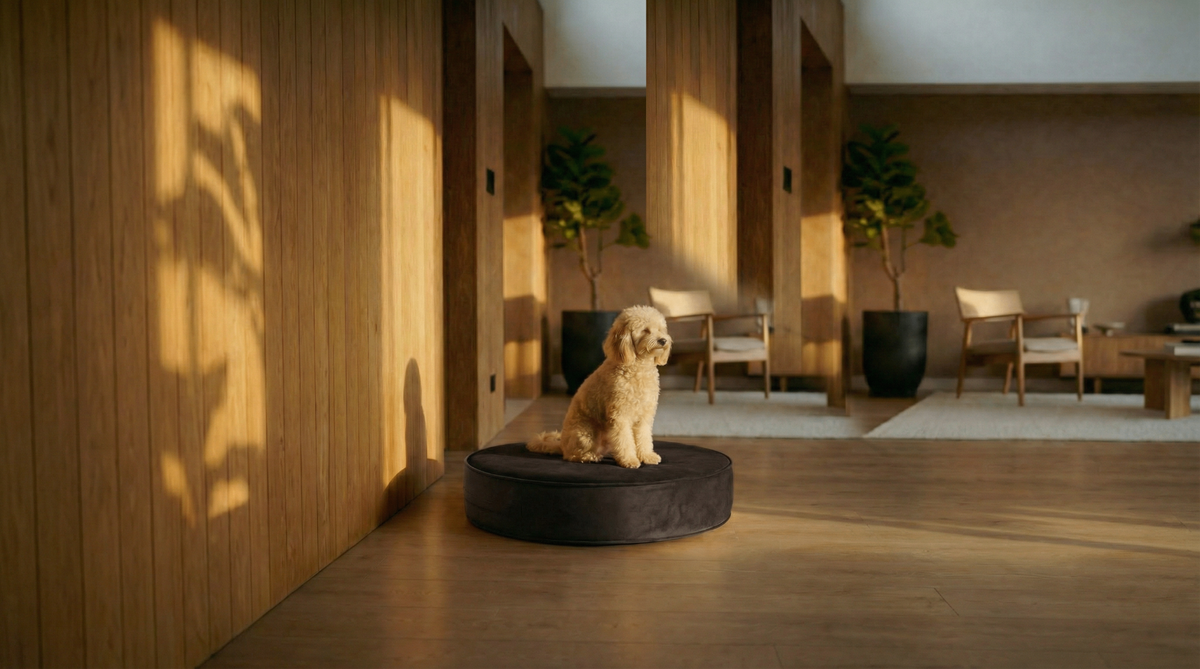
How to Hide Dog Beds in Living Room Decor
Table of Contents
- Why Hiding a Dog Bed Is the Wrong Goal (And What to Do Instead)
- Plan Your Layout: Where to Put a Dog Bed in the Living Room
- Furniture-Grade Dog Beds That Blend With Your Decor
- DIY Ways to Hide a Dog Bed Under Existing Furniture
- Choosing Pet-Friendly Fabrics and Materials That Last
- The Best Dog Beds for Interior Design: What to Look For
- Frequently Asked Questions
Last Updated: October 1, 2026
Why Hiding a Dog Bed Is the Wrong Goal (And What to Do Instead)
Most guides on how to hide dog beds in living room decor start with a flawed premise. A dog bed is not clutter to conceal, it is furniture your dog uses daily, and treating it like an eyesore leads to cramped solutions.

Plan Your Layout: Where to Put a Dog Bed in the Living Room
Placement decides whether a dog bed looks intentional or awkward. Start with the room's existing flow, not a random corner.
Dead Space Use: Corners, Under Windows, and Beside Sofas
Look for dead space first. Every living room has spots that hold nothing useful.
- The corner behind a sofa
- The nook under a window
- The gap between a console and a wall
- The strip beside a fireplace or media unit
Small-Space Layouts: Tuck-Away Solutions for Apartments
Small rooms need beds that pull double duty. A round ottoman bed works as a footrest when your dog is not using it. A crate that doubles as an end table frees up floor space entirely.
- Ottoman bed that doubles as seating
- End table crate for small dogs
- Console with a built-in bed slot
- Floor cushion that stacks away
Furniture-Grade Dog Beds That Blend With Your Decor
The fastest way to make a dog bed disappear into your decor is to buy one that already looks like furniture. Furniture-grade dog beds use the same materials and proportions as the pieces around them.
Ottoman Beds, Console Table Integration, and End Table Crates
Three shapes do most of the work, each solving a different layout problem.
- Ottoman beds: round or square, they read as seating. The Circle from Mafé Pets is a sculptural round ottoman bed with a high-density foam core and a zip-off, machine-washable cover.
- Console table integration: a long, low bed slides under a console. It stays out of sight until your dog claims it.
- End table crates: a crate with a flat top becomes a side table. Best for smaller dogs.
DIY Ways to Hide a Dog Bed Under Existing Furniture
Most guides stop at "slide a bed under a console." That works only if the clearance, materials, and airflow are right.
Raise a Sofa or Console on Risers
What you need: four furniture risers rated for the weight of the piece, a tape measure, and a level.
Steps:
- Measure the height of your dog's bed, including the loft of the foam after your dog lies down. Add 2 inches of headroom so your dog can sit up without hitting the frame.
- Measure the height of the furniture legs. Standard sofas sit 4 to 6 inches off the floor. A typical orthopedic bed is 3 to 5 inches tall, so most sofas need 2 to 4 inches of lift.
- Choose risers rated for at least the weight of the furniture plus anyone who sits on it. A three-seat sofa can weigh 200 to 300 lb empty, so pick risers rated well above that.
- Lift one corner at a time and seat each riser under the leg. Check level before lowering the full weight.
- Re-check stability by pressing down on each corner. If the piece rocks, the risers are mismatched or the floor is uneven.
Add a Fabric Skirt to a Low Table or Console
What you need: fabric (canvas, linen, or a washable upholstery blend), iron-on hem tape or a sewing machine, and hook-and-loop tape.
Steps:
The Circle — Round Ottoman Dog Bed →
- Measure the front width of the table and the drop from the tabletop to 1 inch above the floor.
- Cut the fabric 2 inches wider than the front and 2 inches longer than the drop for hem allowance.
- Hem the sides and bottom. Iron-on tape works if you do not sew; press firmly for 30 seconds per section.
- Attach hook-and-loop tape along the top edge of the fabric and the underside of the tabletop. This lets you pull the skirt back for cleaning or to check on your dog.
- Leave both ends open. A skirt on the front only is enough to hide the bed and keeps air moving.
Build a Simple Plywood Platform
What you need: one sheet of 3/4-inch plywood cut to the bed's footprint plus 2 inches on each side, four 2x4 legs cut to 3 to 4 inches, wood screws, sandpaper, and a paint or stain that matches your trim.
Steps:
- Cut the plywood to size at a hardware store; most will make the cut for you.
- Cut four legs from a 2x4. Three inches is enough for most rooms; go to four to sit flush with a sofa base.
- Screw the legs into the underside at each corner, inset 1 inch from the edge.
- Sand all edges. A rounded edge is safer for tails and paws than a sharp corner.
- Seal with paint or stain. Let it cure fully before your dog uses it.
Safety and Ventilation: What to Check Before You Enclose a Bed
Enclosed spaces trap heat and stale air. Before you tuck a bed under anything, check these points.
- Airflow: leave open sides so air moves through
- Headroom: your dog must sit up without hitting the underside
- Escape route: never block the only exit
- Heat sources: keep beds away from vents, radiators, and electronics
- Stability: anchor risers and platforms so nothing tips
Choosing Pet-Friendly Fabrics and Materials That Last
Fabric choice decides how a bed looks after a year of daily use. Good ones hold their shape. The difference comes down to fiber, weave, and how the cover attaches.
Fiber and Weave: What Actually Survives a Dog
A tight weave beats a thick pile every time. Run your hand across the fabric; if fibers pull loose, your dog's claws will do the same.
The Details Most Buyers Overlook
- Zip-off covers: a cover that comes off in one piece and goes in a standard machine wash is the single biggest factor in long-term appearance. Look for a hidden zipper with a fabric guard so your dog cannot chew it.
- Waterproof liners: a sealed liner between the cover and the foam protects the core from accidents, drool, and spills. Without one, foam absorbs odor and cannot be fully cleaned.
- Reinforced seams: double-stitched seams at stress points (corners, zipper ends) resist tearing when your dog digs or circles before lying down.
- Non-skid bottoms: a rubberized or textured base keeps the bed from sliding across hardwood or tile when your dog jumps in.
A Simple Decision Framework
| If your dog... | Choose | Avoid |
|---|---|---|
| Digs or scratches before lying down | Microvelvet or tight-weave canvas | Looped weaves, linen, sherpa |
| Runs warm or lives in a humid climate | Breathable canvas or linen blend | Heavy faux fur, thick pile |
| Is a puppy or senior with accidents | Any cover with a sealed waterproof liner | Non-removable covers, unlined foam |
| Sheds heavily | Tight weave in a color close to your dog's coat | Dark fabrics that show light hair, or vice versa |
Color and Pattern in the Room
A bed blends best when its cover echoes something already in the room. Pull a color from your rug, throw pillows, or artwork: a solid mid-tone reads as furniture, while a busy pattern competes with your decor. Match the bed to the sofa or floor to make it recede, or to a pillow or artwork to make it a deliberate accent.
The Best Dog Beds for Interior Design: What to Look For
The best dog beds for interior design share a few traits: real materials, shape retention, and proportions that fit the room.
| Feature | Why It Matters | What to Avoid |
|---|---|---|
| Frame material | Holds shape for years | Thin plastic or wire |
| Foam type | Supports joints | Loose shredded fill |
| Cover | Washes clean | Non-removable fabric |
| Liner | Blocks accidents | None |
| Warranty | Protects your money | No coverage |
Frequently Asked Questions
How do I hide a dog bed in a small living room?
In a small living room, use dead space: tuck a low-profile bed under a console table, place it in a corner behind a chair, or choose a round ottoman bed that doubles as a footrest. Measure your available floor space first, then pick a bed with a compact footprint. A bed like The Circle (round, 30 inches wide) fits under many coffee tables or beside a sofa without blocking walkways. Avoid bulky square beds that eat floor space.
Can a dog bed double as a piece of living room furniture?
Yes. Furniture-grade dog beds are built with hardwood frames and upholstery that match your sofa or chairs. An ottoman-style bed works as a footrest when your dog is not using it. A console table with a built-in crate gives you a surface for lamps or books. The key is choosing a bed with a design that matches your existing decor, not a plastic crate or a fluffy donut. Mafé's Haven bed, for example, has a solid North American hardwood frame and tailored cover that looks like a side table.
What are the best dog beds for interior design?
The best dog beds for interior design use real furniture materials: solid wood, high-density foam, and washable upholstery in neutral colors. Look for a bed with a waterproof liner and a machine-washable cover to keep it clean. Mafé's Haven bed ($399) has a solid North American hardwood frame, orthopedic memory foam, and a ten-year structural warranty. The Circle ($150) is a round ottoman bed with a high-density foam core and a sculptural shape that works as a centerpiece.
Are there DIY ways to hide a dog bed under existing furniture?
Yes. You can place a low-profile bed under a console table, a bench, or a coffee table. Always check that your dog can enter and exit without crouching and that air circulates.


%0A%0APlan%20Your%20Layout:%20Where%20to%20Put%20a%20Dog%20Bed%20in%20the%20Living%20Room%0ADead%20Space%20Use:%20Corners,%20Under%20Windows,%20and%20Beside%20So...)